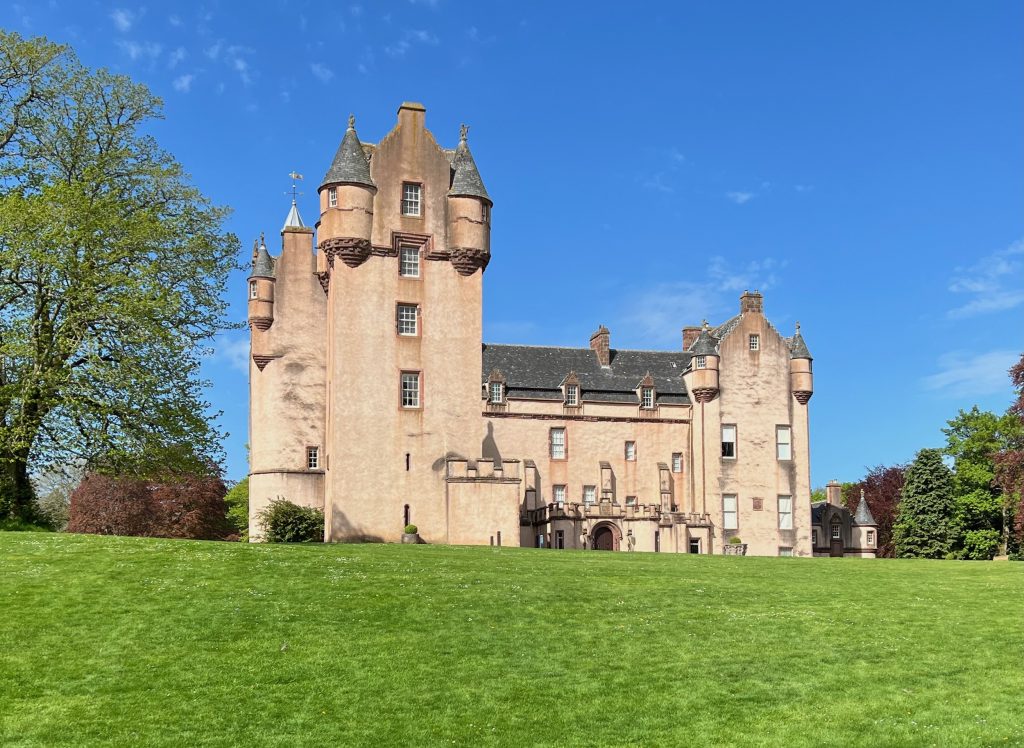
Fyvie Castle
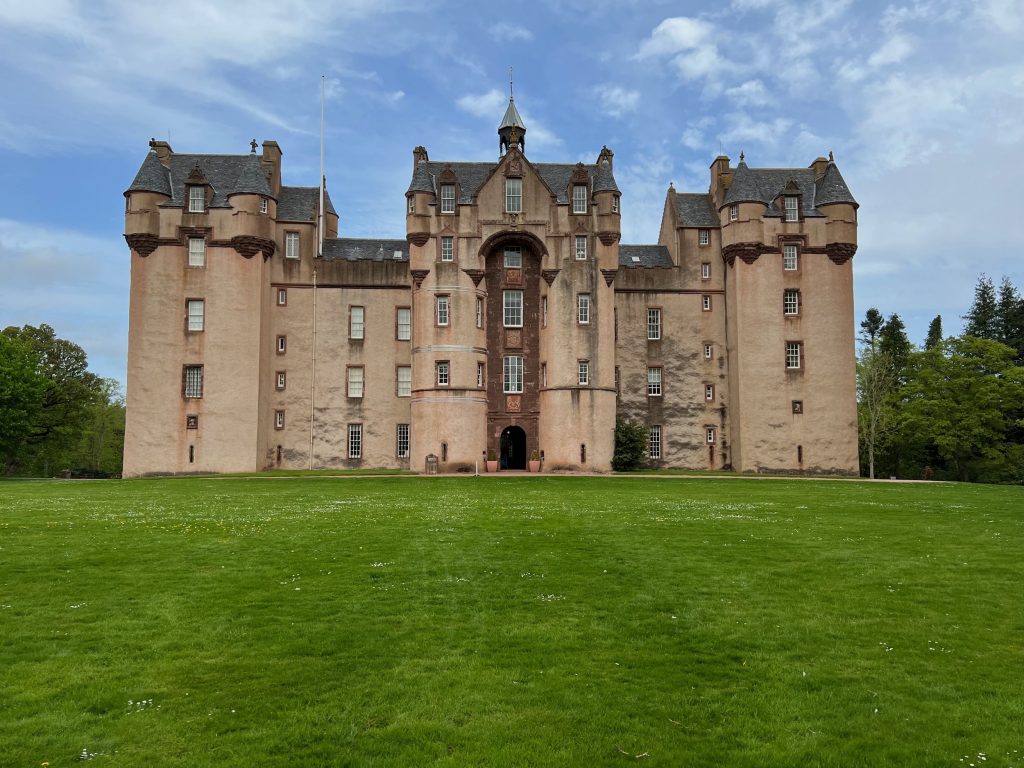
Fyvie Castle is one of Scotland’s Grade A heritage monuments. Located near Oldmeldrum and Turriff in the centre of Aberdeenshire, it is an L-plan palace that lies near a stream of the River Ythan and the small, curved Loch Fyvie. The south-facing main elevation is 45 metres long and the west-facing later wing measures 42 metres.
Before the current castle was constructed, a small quadrangular castle at Fyvie was occupied by successive kings during the 13th and 14th centuries. Perhaps it was built by William the Lion, who lived there; followed by Reginald le Cheyne. This royal residence was often used by Robert the Bruce, especially during his reign as King Robert I (1306–1329). After Robert I’s death of leprosy, the estate was occupied by his eldest daughter, Matilda, during the reign of his young son, David I. When David died in 1370, his former regent became King Robert II, who conferred Fyvie, including its prized eel-fishing rights, to his son John, Earl of Carrick. In 1380, ownership was transferred to his cousin, Sir James de Lindesay (Lindsay) of Crawford.
After Robert III was crowned King of Scotland in 1390, Fyvie gradually transferred to one of his supporters, Sir Henry Preston, who had married Sir James’ sister, Lady Elizabeth Lindsay of Crawford. They had two daughters: one whose name is unknown and the other named Mariota Marjory Preston.
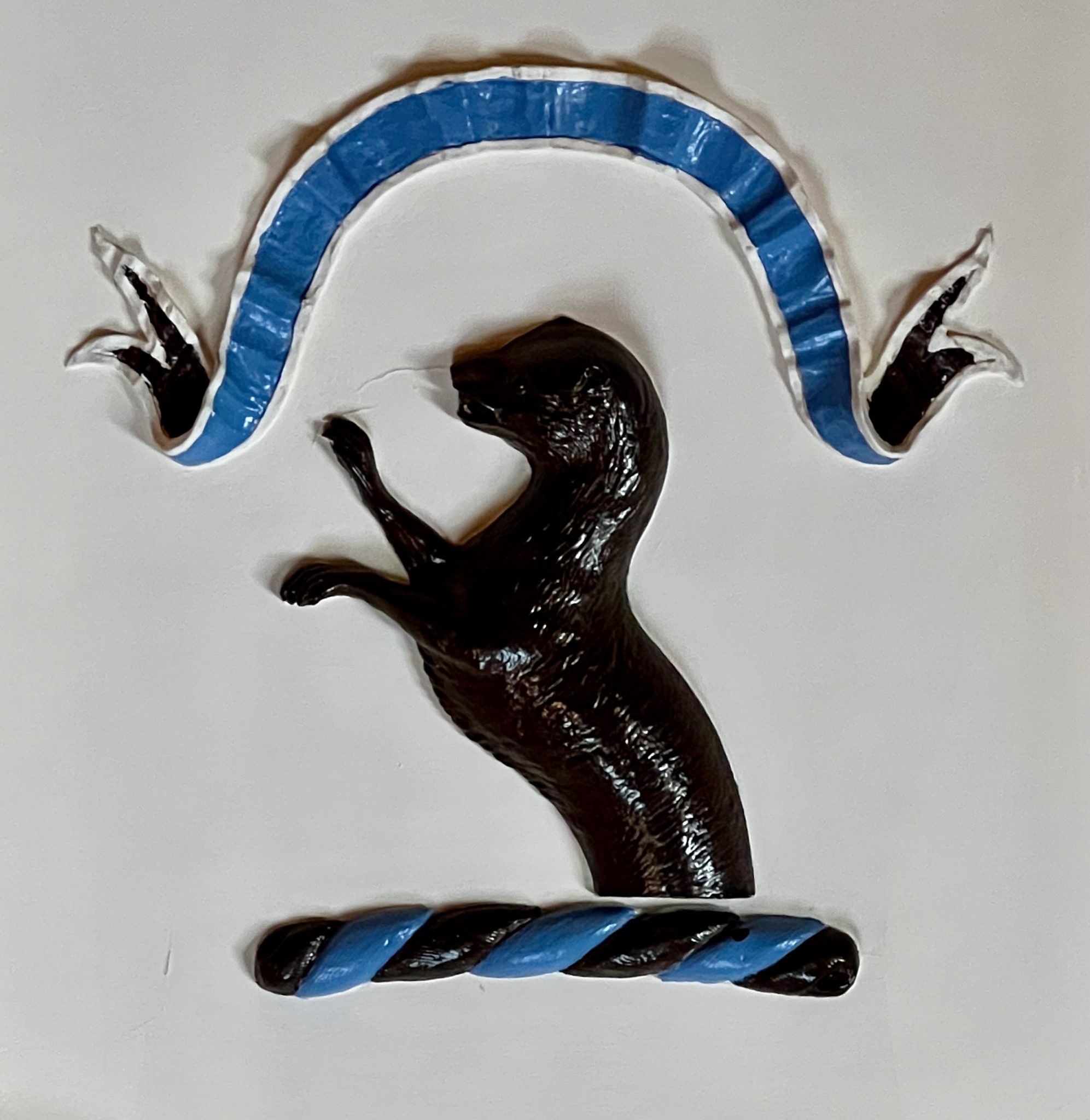
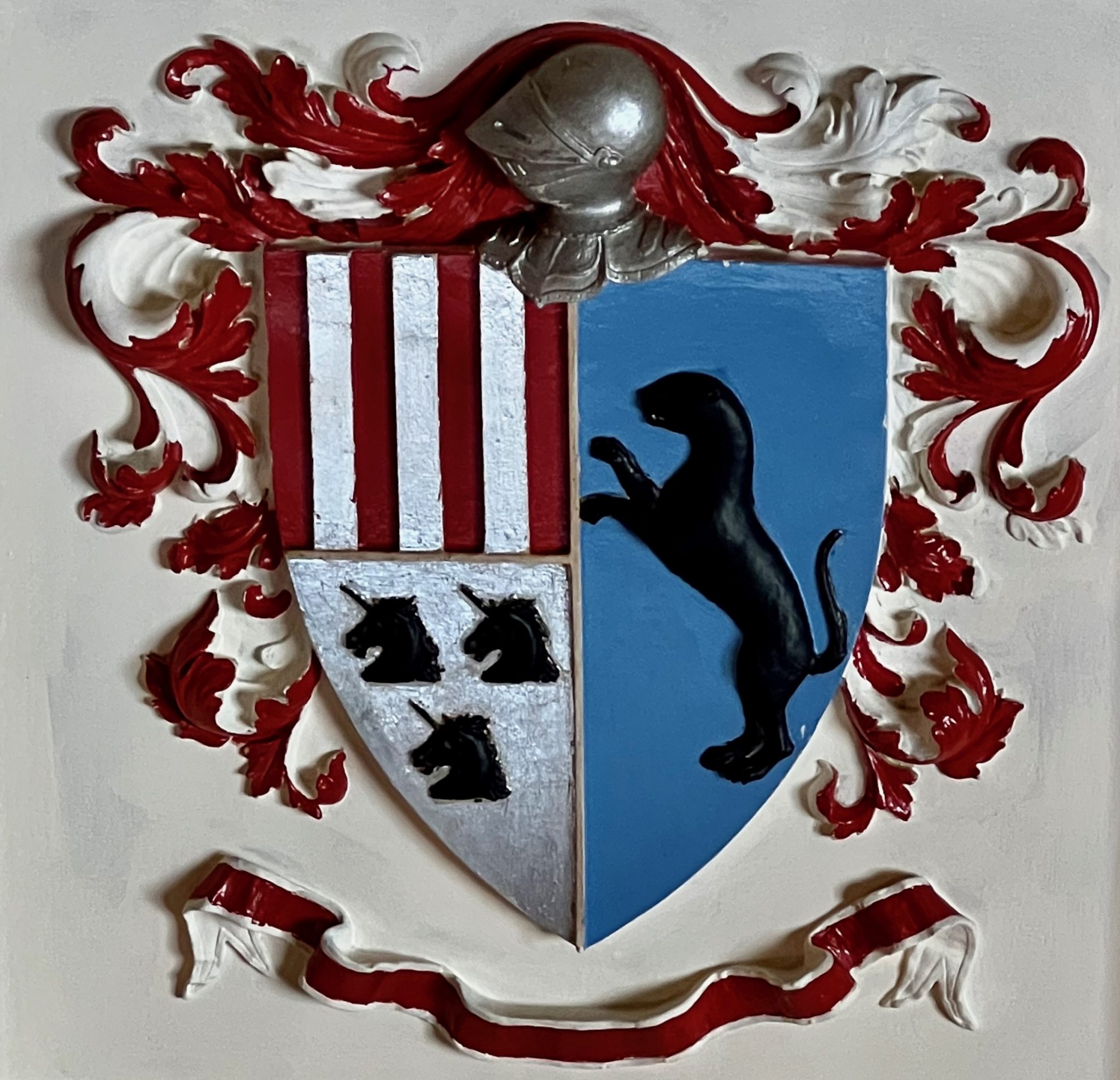
Both Sir James Lindsay and his brother-in-law, Sir Henry Preston, distinguished themselves as Scottish warriors against the English in the legendary Battle of Otterburn, waged in the north-east of England in August 1388. Perhaps this battle was the origin of the otter (or occasionally three otters) that were depicted on the early Meldrum heraldic shields.
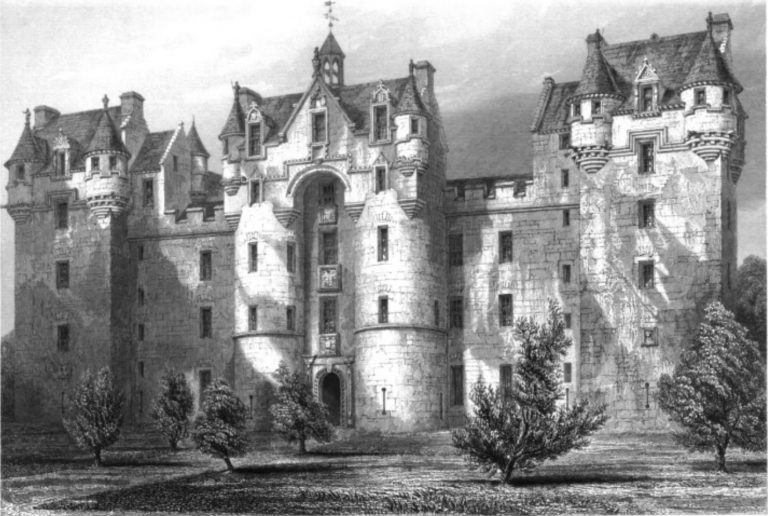
Today’s castle is distinguished by four impressive towers that were built by successive owners. Preston built the south-east corner tower around 1402; Alexander Meldrum and his descendants then built the south-west corner tower and perhaps most of the south range during the 15th and 16th centuries. In the late 16th century, Sir Alexander Seton built the major entrance, including a great wheel stair tower, in the centre of the south façade, and topped the Preston and Meldrum towers with turrets and dormers that might have been worked by the renowned Bel family of masons. About 1770, General William Gordon built the north-west corner tower. A later owner, Alexander Leith (Baron Leith of Fyvie), bought the castle in 1885 and built a new entrance and tower beside the Gordon tower; completed between 1890 and 1905. His descendants, the Forbes-Leiths, sold Fyvie to the National Trust of Scotland in 1984.
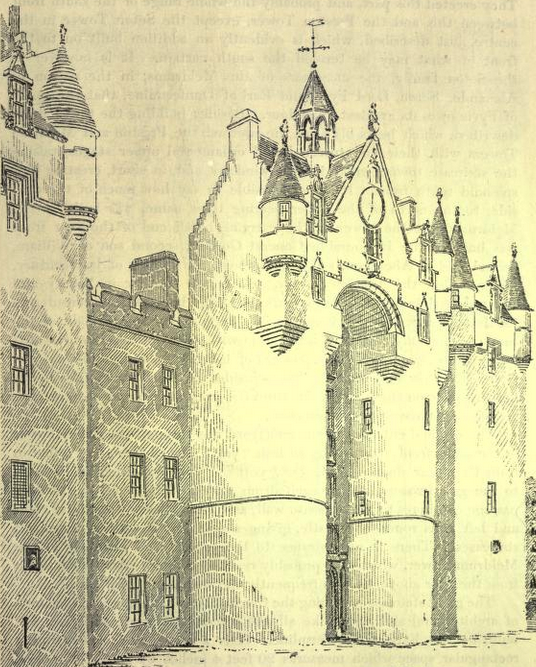
All three corner towers are square structures topped with angle turrets and tall, crow-stepped gables, while the Seton pavilion is a pair of cylindrical towers, about 13 metres high, framing a massive arched gateway. With turrets, dormers and corbelled oriels around the central gable, this tower was described by late 19th century architects David MacGibbon and Thomas Ross as ‘perhaps the most imposing front of any ancient domestic edifice in Scotland’.
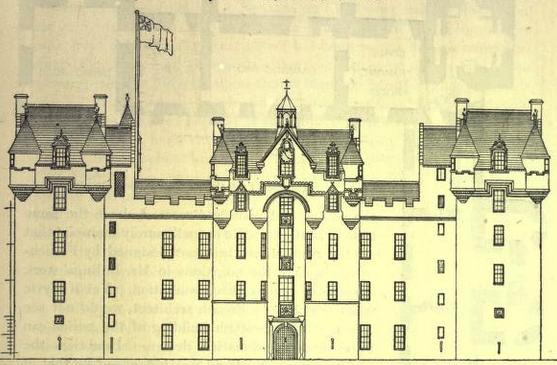 South elevation of Fyvie Castle (MacGibbon and Ross).
Meldrums owned Fyvie Castle from about 1433 to 1596. After Sir Henry and Lady Elizabeth Preston died, their eldest daughter (name unknown) received the castle and burgh (village) of Fyvie. She relinquished this bequest to her husband, Alexander Meldrum, while her sister, Mariota, transferred her estate, Tolquon Castle, to her husband, John Forbes.
After Alexander Meldrum, Fyvie was held by a son, George Meldrum (an ambassador to the Court of King Henry VIII). In the early 1500s, George’s eldest son, also named Alexander, was afflicted with recurring bouts of madness, perhaps fits of epilepsy, which caused him to sign a contract in 1511 that passed Fyvie to his brother, William, in return for an annuity of one hundred merks. When William died, before 1577, the Crown regranted the land to his son George Meldrum, who became heavily indebted to neighbours Walter and Patrick Barclay, the father and son lairds of Towie.
By April 1593, George and his brother Andrew Meldrum had mortgaged or sold too much land and money to remain at Fyvie. In 1596, all rights to occupy the Crown property were purchased by Alexander Seton, with his mother, Lady Isobell (Hamilton) Seton. The Setons were supporters of the Roman Catholic church and Mary Queen of Scots. Alexander was educated in science, law, philosophy and architecture at the German and Roman College in Rome during the 1570s, perhaps sponsored there by Pope Gregory XIII. In the 1580s and 1590s, as Lord Urquhart, he became a Privy Councillor then rose to become Lord President of the Court of Session. In 1598 he became Lord Fyvie. His stellar career continued with appointments as Provost of Edinburgh, an advisor to James VI, and a tutor and guardian of King Charles I. He became the owner and first Earl of Dunfermline Palace in Fife.
When he purchased Fyvie, Alexander was married to his first wife, Lilas (Lilies) Drummond, daughter of Patrick, the 3rd Lord Drummond, who gave birth to five daughters. After her death in 1601, he promptly married a teenaged Grizel Leslie, a daughter of James Leslie, Master of Rothes who bore a son who died young and two daughters before she died in 1606. His third wife, Margaret Hay, daughter of James, the 7th Lord Hay of Yester, bore one son, Charles Seton, who was Lord Fyvie until he succeeded his father as Earl of Dunfermline in 1622, and two daughters.
Heritage Listing
Britain’s Grade A heritage listing for Fyvie Castle states that it is a ‘large L-plan block (quadrangular prior to 1777 with N. and E. sides ruinous) comprising:
—S. RANGE 147′ long, originally 15th century (incorporating Preston Tower c 1400 at S.E., Meldrum Tower built at S.W. in form symmetrical front), reduced to width, upper parts of centre pair of arch linked D-plan towers flanking old entrance (The Seton Tower) and upper parts of Preston and Meldrum Towers added 1599 (dated) for Alexander Seton Earl of Dunfermline. N. wall demolished and rebuilt; range again widened though not to pre 1599 width 1777–93 for Gen. Hon. Wm. Gordon. N. wall again remodelled, clock tower added A.A. Marshall Mackenzie 1899. 3-storey and attic, towers 4-storey and attic with angle turrets, harled, richly detailed red sandstone dressings.
—W. RANGE 3-storey and attic 137′ long, 1603 perhaps incorporating older work, with great wheel stair 20’4″ x 18’6″ at N. end, beyond which Gordon Tower erected 1777 on site of chapel to match original Seton work; buttresses added about same date. Single-storey crenellated vestibule added on E. side after 1816, circular turrets originally had conical roofs. Squinch turret in angle and other alterations A. Marshall Mackenzie 1913 and 1920. Leith Tower at N.W. adjoining Gordon Tower John Bryce 1890, 3-storey and attic with Huntly-type oriels, incorporating at rear butler’s house originally built c. 1816/20 but remodelled 1890. Fine interior work throughout, panelled charter room, fine plaster work by Robert Whyte 1683 in old dining room now morning room etc.’
Curses, Ghosts and Death Chambers
Fyvie Castle is said to be haunted by at least two ghosts—the Grey Lady and the Green Lady—and by medieval curses and sinister death chambers. Here are some key legends:
—In the mid-1200s, a poet-prophet named Tammas the Rhymer was in the habit of casting dark curses on many of Scotland’s noble families. He was said to have arrived at Fyvie Castle in the midst of a violent storm and to have cast a curse that no male heir of an owner would be born in the castle (which proved true for 500 years), and that bad luck would befall the castle’s occupants while three ‘weeping’ stones (which alternated between dry and wet surfaces) remained on the wrong side of an ancient boundary between church and the Crown land. It is said that one of the stones was built into the Preston tower, another lies at the bottom of Fyvie loch and the third is now in the castle’s Charter Room.
—Another curse seems to have been applied in the time of Henry Preston’s son-in-law, Alexander Meldrum, who is claimed to have tortured and starved to death one or more victims in a windowless, inaccessible dungeon at the base of the Meldrum tower. The curse was applied to anyone who tried to get into the chamber; whereupon ‘the Laird of that day would surely die and his leddy would go blind of her e’e’.
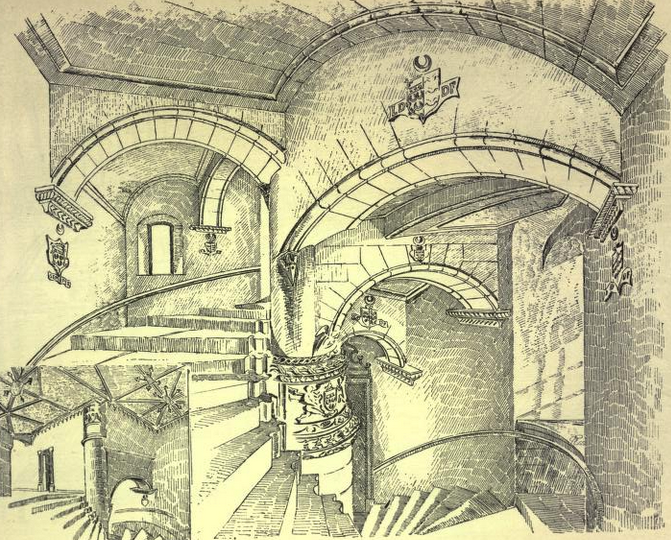
—At the top of the great wheel stair tower built by Lord Fyvie, Sir Alexander Seaton, in the early 1600s, a small room is named the ‘murder room’ and a nearby chamber is named the ‘ghost room’. It has been claimed that a lady was confined by her angry husband in the murder room, which seems to have a bloodstained floor, and that one or more bold rescuers were murdered by her guard, then thrown from the window. On the edge of madness and death from starvation, the woman was moved to a nearby chamber, which has been haunted by a Grey Lady? wraith since her death and is known now as the ‘ghost room’.
—After siring five daughters, Alexander Seton was anxious for a male heir and he turned to his niece, Grizel Leslie, who he married six months after the death of Dame Lilias, in 1601. On their wedding night, spent in a bedroom of the Preston Tower, the new couple heard heavy sighs outside their room. In the morning, they found the name of his dead wife carved in large letters on the windowsill. This upside-down inscription still can be viewed by visitors to this bedroom.
—The Green Lady ghost regularly troubled guests sleeping in the former Gordon dressing room. In the early 20th century, one guest, a Canadian mining engineer, said that he had woken in the early hours of several consecutive mornings to find his room illuminated by a bright, iridescent-green glow and felt that he was in the presence of an invisible living being. It is believed that this Green Lady is the unidentified subject of a 1676 portrait of a lady in a blue gown, which for many years hung on the hallway wall outside the haunted bedroom. This was removed by a 19th century owner of Fyvie, and was sold to a doctor, whose descendants returned it to the Laird Forbes-Leith in 1906.
—During renovations by the Forbes-Leith family in the 1920s, a woman’s skeleton was found behind the wall of a bedroom. When she was buried in the local cemetery, the castle’s occupants began to notice strange noises and incidents. These phenomena stopped when the skeleton was resumed and replaced behind the bedroom wall.
References
—Anna Maria Wilhelmina Stirling, 1928, Fyvie Castle: Its Lairds and Their Times. London: John Murray.
—David MacGibbon and Thomas Ross, 1887, The Castellated and Domestic Architecture of Scotland From the Twelfth to the Eighteenth Century, vol. 2. Edinburgh: David Douglas, pp. 348–355.
—’Fyvie Castle’, British Listed Buildings website.
—‘Fyvie Castle LB9615’, Historic Environment Scotland website.
—‘Fyvie Castle’ Undiscovered Scotland website.Crombie Castl3 in
—‘Fyvie Castle’, Wikiwand.
—‘Fyvie Castle Ghosts’ WikiTree.
—‘History’, The House of Gordon website.
—Maureen M. Meikle, 2013, The Scottish People 1490–1625. Lulu.com ebook (Google Books preview).
—Scotiana https://www.scotiana.com/scotianas-favourite-castles-fyvie-castle-part-i/
—Simon Forder, ‘Fyvie Castle’, The Castle Guy website.
—Sue Coburn, 2016, Fyvie Castle: Its Lairds and Their Times, Kindle edn. [Update of Stirling, 1928.]
—Sue Coburn, 2016, Fyvie Castle: Unexplained, Kindle edn.