
Dumbreck Castle
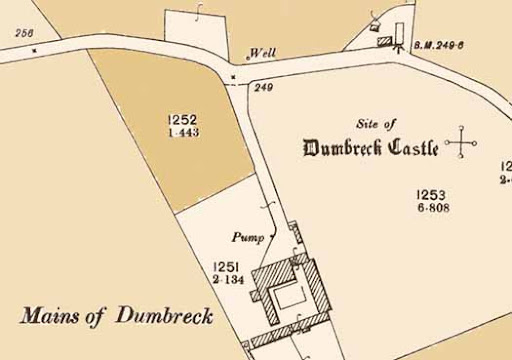
Now demolished, this early 16th century tower house was built by Meldrums after purchasing nearby land from the Dumbreck family’s Mains of Dumbreck property in Aberdeenshire. Some historians have suggested that the architect of Dumbreck Castle was probably Thomas Leper, who designed nearby Tolquon Castle. Both buildings included gun loops of a similarly distinctive style.
After the original castle was demolished by later owners, some architectural fragments were built into newer buildings on the farm. The left side of a gun loop adorns the easterly gable of the farmhouse, while a carved stone fragment is built into the north wall of an outbuilding.
Note
Scotland’s earliest armorial (register of heraldic shield designs), the Forman-Workman manuscript published in 1562, wrongly attributes one of the Meldrum blazons (written description of a shield design) to ‘the Dumbrecks of that Ilk’ (although the last man of the Dumbreck line died at the Battle of Pinkie in 1547. The Forman-Workman armorial described the Dumbreck arms as including an otter seizing a salmon, with two fleur-de-lis in chief; all Meldrum symbols that probably relate to the Battle of Otterburn (a Scottish victory against the English in mid-1388) and the clan’s Normandy origins. Later Scottish armorials [Seton, 1591, and Balfour, 1640] describe the Dumbreck shield design as ‘a wolf transfixed with a dagger hilted gules’ (meaning the dagger was coloured red to its hilt).
References
—’Dumbreck Castle’, Wikipedia.
—William Vincent Dumbreck, ‘Historical Info’, Dumbreck family website.