
Cleish Castle
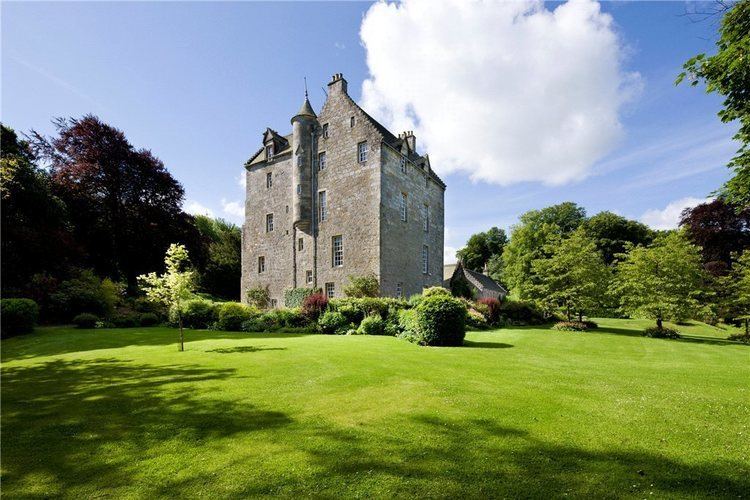
Cleish Castle is a 16th century, L-plan tower house on a large property at the base of the Cleish Hills, near the Cleish hamlet, five kms south-west of Kinross. Originally in Fifeshire, now Kinross-shire, it was built on or near the Cleish and Bynnis baronial lands that were inherited in the early 1500s by William Meldrum, the heroic and romantic subject of Sir David Lyndsay’s mid-16th century duet of poems, The Historie and The Testament of Squyre Meldrum.
The original Cleish Castle was built by several generations of the Colville family after 1530, when Sir James Colville exchanged his estate at Ochiltree for lands at Lochoreshire, Fife, and Easter Wemyss, which included the barony of Cleish. In 1537, when Sir James was being accused of treason, he gave the Cleish estate and its barony to Robert Colville, one of his two illegitimate sons.
The mansion, now a Grade A-listed heritage item, includes two lower floors that appear older than the upper three levels and the attic might have been added in 1600, which is the date carved on a dormer window (along with the initials of Robert Colville, the 3rd Baron of Cleish, and his wife, Beatrix Haldane). It is believed that the Colvilles planted many of the substantial trees around the estate, including a magnificent avenue of yews which defined the original driveway.
After the castle was sold to the Graham family in 1775 and the Young family by 1800, it was abandoned and derelict for some decades before it was renovated and extended by Edinburgh architect John Lessels, who reduced the thickness of some stone walls that were originally 7 to 9 feet deep. Further renovations were completed in the 1970s and the 1990s.
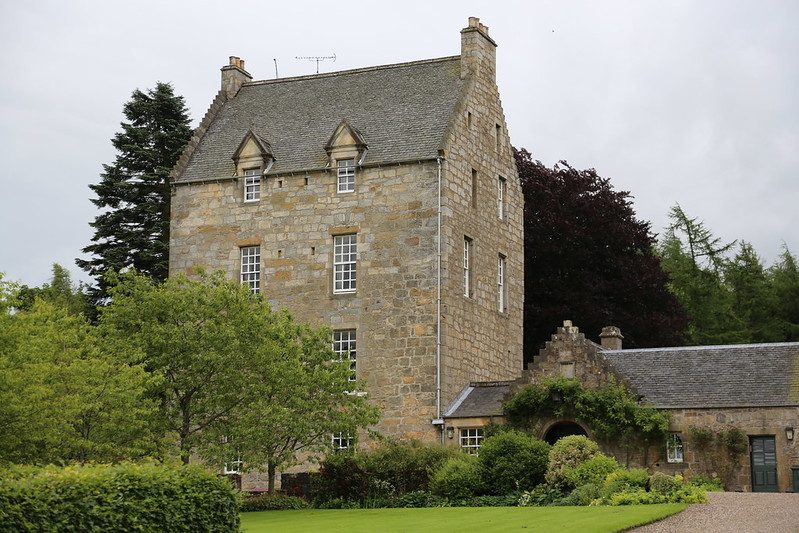
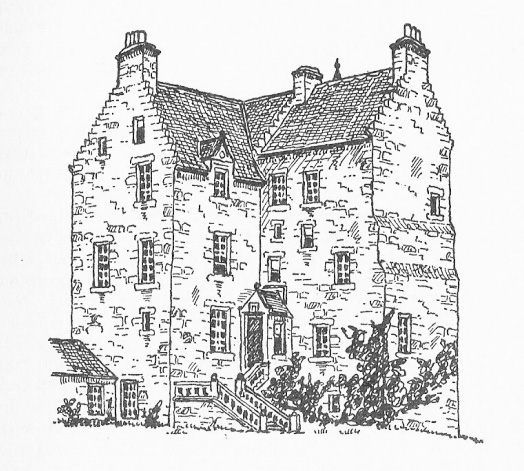
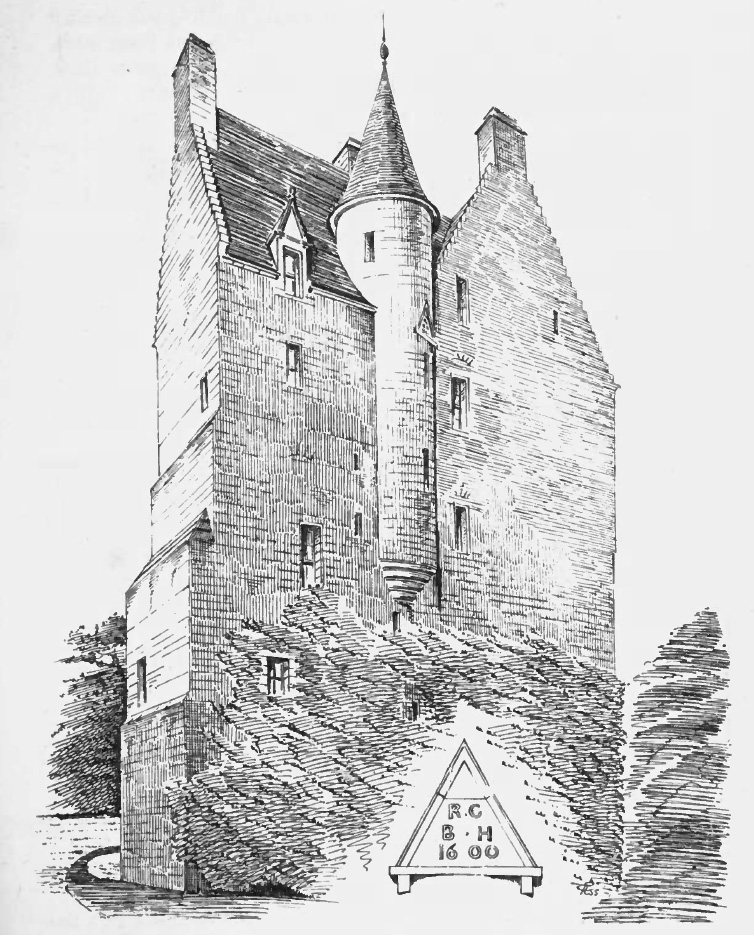
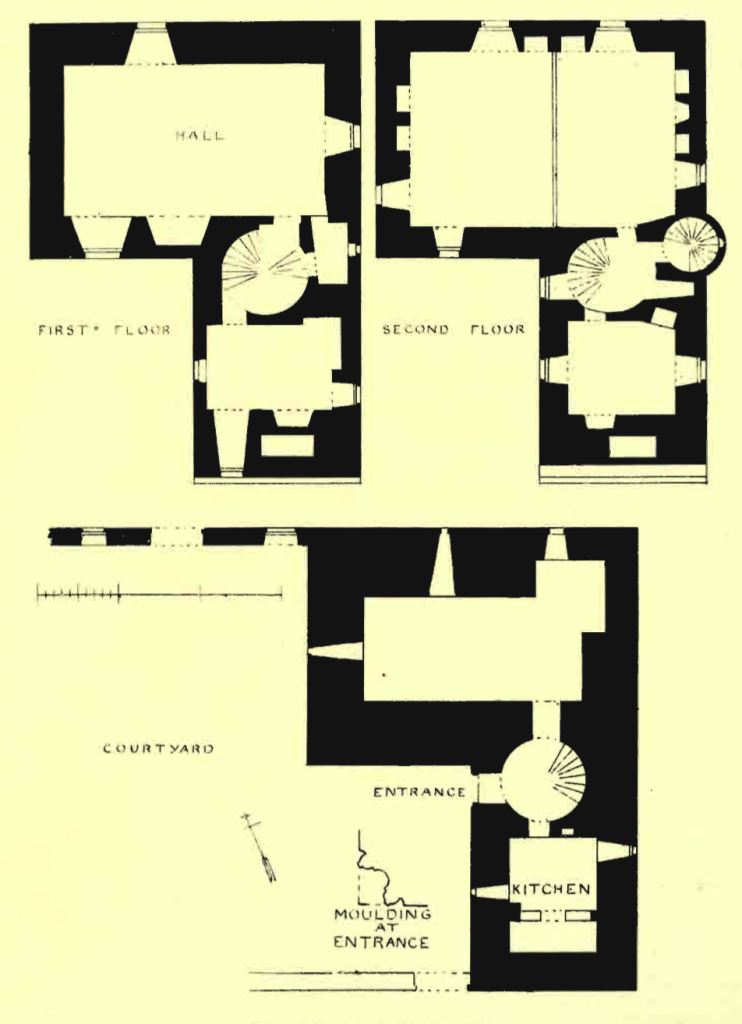
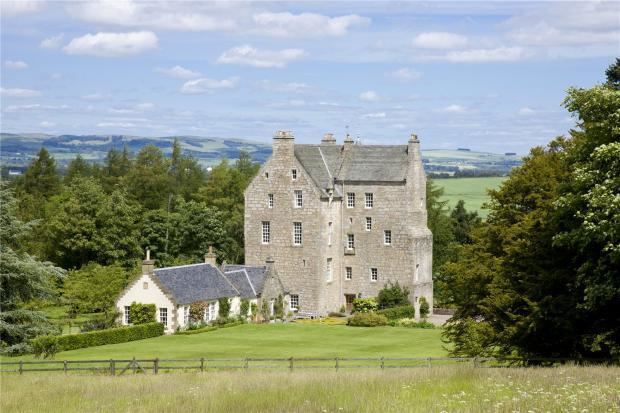
The Grade A listing of Cleish Castle by Historic Environment Scotland includes this technical description:
16th cent. Tower-house. L-plan. 3 storeys (and garret) on basement. Coursed rubble. Corbie-steps. Slated roof. Interior altered in 1845 but kitchen with great fireplace still exists in 1st storey. Turnpike stair to 2nd storey. Corbelled stair-turret on E side has inserted pediment inscribed ‘R.C./B.H. 1600’. Additions (c. 1840): Porch and stair in re-entrance angle; offices (with earlier sundial dated 1711) on west end. Formerly it had a court. A notable feature is the S. gable which rises in a series of offsets. The walls were thinned in 1845, vaulting was removed from basement chamber of main block. Windows were enlarged.
References
—’Cleish Castle‘, Canmore website.
—’Cleish Castle‘, David MacGibbon and Thomas Ross, The Castellated and Domestic Architecture of Scotland, vol. 3, pp. 569–572.
—’Cleish Castle LB6711‘, Historic Environment Scotland website.
—’Cleish Castle‘, Wikipedia.
—’Sir James Colville of Easter Wenyss‘, Geni website.