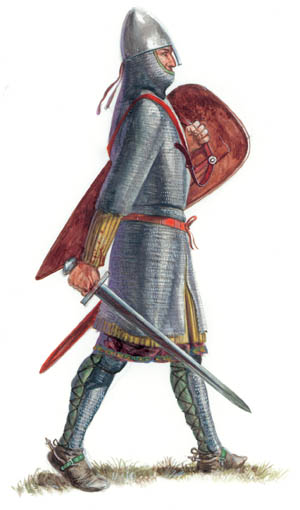
Norman origins | 1200s
Introduction
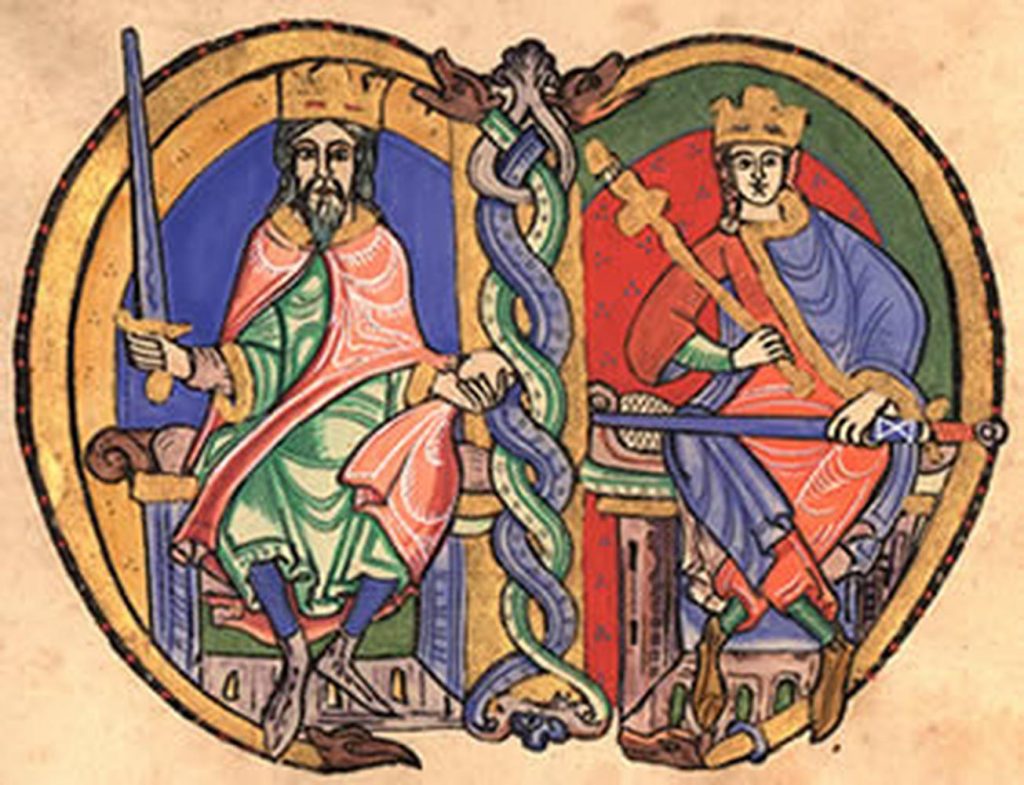
The invasion of Scotland by kings and knights from Normandy began in 1054, and battles became more frequent during the 1100s. After King David I was inaugurated at Scone in 1124, he granted the lands of Annandale to Norman warrior Robert de Brus (Robert the Bruce). Later Scottish kings William I and Alexander II granted further lands to Norman and Flemish nobles who were loyal to them against local rebels.
The first Norman earl in Scotland was William Comyn, who c. 1212 married Marjory, the heiress of Fergus, in the province of Buchan. William became the 1st Earl of Buchan. By 1286, more Scottish earldoms and baronies were granted to men of Norman origin. One of these was the barony of Meigdrum (Meldrum) that was created when one of William’s daughters, Agnes, married Philip de Phedarg, the son of Norman knight, Philippus de Phedarg. These two Norman knights were the founders of today’s international Meldrum clan.
Early 13th Century
—A Norman knight, Philippus de Phedarg (aka Feodarg, Fendarg), Phendarg, Fyndarg), arrived in Scotland from France to settle. In 1236, he was granted a large estate in the area known as Belthenie, including today’s village of Oldmeldrum. These lands had been earlier settled by the Romans, then the Picts.
Mid-Late 13th Century
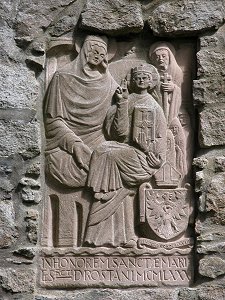
—Philip de Fendarg was knighted and anointed Baron of Meigdrum (aka Meall-drium, Meall-droma; mostly recorded as Meldrum) and was granted the lands of Achathnaneve (Auchineve, near Tarves, by Walterus, the Abbott of Arbroath, in return for his family’s loyalty and service. Between 1242 and 1249, he received the lands of Balcormo (aka Balcormack), north-west of Largo in Fife; from Walter of Lundin, a kinsman. Philip married Agnes Comyn, daughter of William de Comyn, the 1st Earl of Buchan and Justicar of Scotia from 1205-1232. Philip also served as Justicar of Scotland from 1251 to 1253.
—Philip and his eldest son, Sir William de Melgedrum, witnessed the royal charter which permitted Alexander Comyn, the 2nd Earl of Buchan, to establish the hospital at Turriff. [‘Meldrum’, Black, 1946, p. 593.]
—Philip’s second son, Thomas Meldrum, established a new branch of the family, the Meldrums of Seggie, while his third son, Alexander Meldrum, established the Meldrums of Cleish. [Barns-Graham family tree.]
—In 1278, Alexander de Melgedrom or Melgedrum witnessed a quitclaim deed relinquishing ownership of the Beeth Waldef estate. [‘Meldrum’, Black, 1946, p. 593.]
—In 1296, David de Melkedrom of Fife and William de Melkdrom, Sherriff of Aberdeen (in 1292), gave allegiance to Edward I of England by signing the Ragman Roll. [‘Meldrum’, Black, 1946, p. 593, citing Bain, 1900, vol. 2, pp, 140, 209.]